Culture
When is Bike to Work Day? The dates around the world, and how to ride your first one
In the United States, Bike to Work Day falls on a Friday in mid-May, inside Bike to Work Week and National Bike Month: in 2026 it was Friday 15 May. Other countries keep their own dates, from Britain's Cycle to Work Day on the first Thursday of August to Australia's National Ride2Work Day in October. Here is the calendar, and a plan for riding the first one.
When is Bike to Work Day?
It depends on where the bike is parked. The best-known version is American: the League of American Bicyclists promotes National Bike Month every May, a campaign it dates to 1956, and places Bike to Work Week and Bike to Work Day inside it. In 2026 the week ran from 11 to 17 May and the day itself fell on Friday 15 May, as announced on the League's National Bike Month page. The day is not a public holiday and nobody checks a ticket. It is a date on which a city agrees to notice the people who ride to work, and on which anyone curious about going to work by bike gets company for the first try.
Outside the United States the idea travels under other names and on other dates. Britain has Cycle to Work Day, Australia has National Ride2Work Day, Denmark and Germany run long workplace campaigns, and much of Europe hands streets to bikes in September. Even inside the United States the calendar is not uniform: the Denver region in Colorado holds its own Bike to Work Day in June rather than May.
Which bike-to-work days fall when?
The table gathers the dates a commuter is most likely to meet. Where the organiser publishes a fixed rule, the rule is given; where it only publishes the current year, that year is shown.
| Event | Where | When | Format |
|---|---|---|---|
| Bike to Work Day, inside Bike to Work Week and National Bike Month | United States | May; Friday 15 May in 2026 | One day in a themed month |
| Bike to Work Day (Denver region) | Colorado, United States | Fourth Wednesday in June | One day |
| World Bicycle Day | Worldwide | 3 June | One day |
| Cycle to Work Day | United Kingdom | First Thursday of August | One day |
| European Mobility Week | Europe | 16 to 22 September, ending with Car-Free Day | One week |
| National Ride2Work Day | Australia | October; Wednesday 14 October in 2026 | One day |
| Vi Cykler til Arbejde | Denmark | May | A month, in teams of colleagues |
| Mit dem Rad zur Arbeit | Germany | 1 May to 31 August | A season |
Local organisers can move or extend any of these, so the page of the city or of the national cycling body has the last word for a given year. A rule such as "first Thursday of August" is the safer thing to remember than a calendar date, because the date changes every year while the rule rarely does.
Is Ride to Work Day the same thing as Bike to Work Day?
In spirit, yes; on the calendar, no. National Ride2Work Day is the Australian event, run by Bicycle Network through its Ride2Work program. Its 2026 edition fell on Wednesday 14 October, in the southern spring, which is why Australian riders celebrate the ride to work just as the northern hemisphere is putting its lights back on. Bicycle Network invites riders to register and to take a pledge, and it suggests that workplaces host a breakfast for the people who ride in.
Britain's version is Cycle to Work Day. Cycling UK describes it as taking place on the first Thursday of August, with the plain aim of getting as many people as possible to ride to work that day, or near enough. It should not be confused with the Cycle to Work scheme, the salary-sacrifice arrangement through which many British employees buy a bike: the day is an invitation, the scheme is a payroll mechanism. Whatever the label, bike to work, ride to work or cycle to work, the request is the same. Make one ordinary trip by bike and see how it feels.
What happens on the day itself?
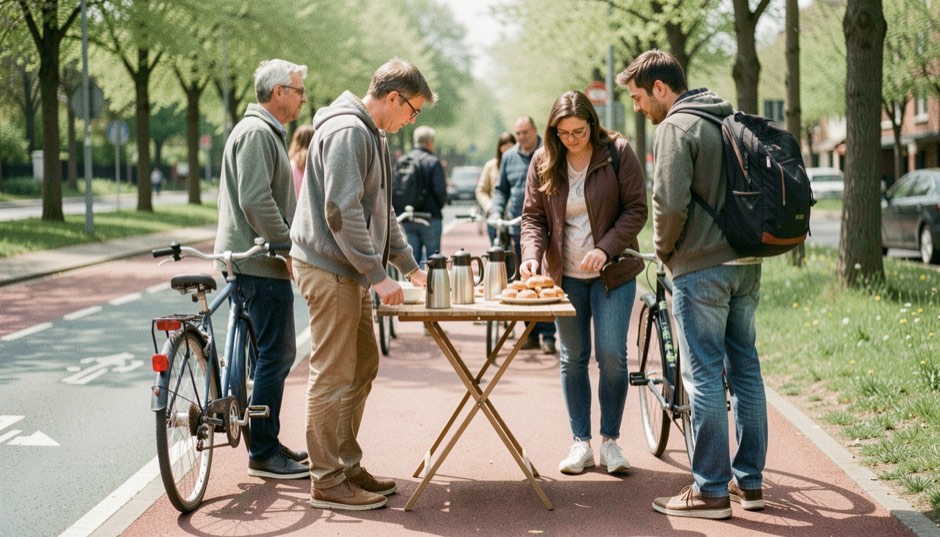
Mostly, people ride to work, which sounds like an anticlimax until you see a street where it happens at scale. The visible layer is the stop along the way. American organisers set up what they call energizer stations or fueling stations: tables on popular routes offering coffee, breakfast and sometimes a quick bike check. In the Denver region, the Denver Regional Council of Governments lists stations across the area serving coffee, breakfast and giveaways, and riders who pledge on its website are entered into a prize draw. Workplaces run their own version: a breakfast at the bike racks, or a group ride from a meeting point.
None of it is compulsory. A rider who passes every station and simply arrives on time has taken part as fully as anyone. The stations exist for the newcomer: they turn a lonely experiment into a shared one, and they give a first-timer a reason to stop halfway and notice that the ride is going fine.
How do you plan a first ride to work for the day?
Treat the day as the deadline and the week before as the preparation. Ride the route once at the weekend, at roughly the hour you will ride on the day, so that the junctions and the traffic pattern are no longer a surprise. The fastest road for a car is rarely the right road for a bike, and our guide to finding a calm route to work explains how to choose one with a map, a test ride and honest timing.
Then check the machine. Tyres pumped, brakes biting, chain wiped, lights charged even if you expect to arrive in daylight, and a lock that is worth the bike. The commuter's kit list sets out what to buy first and what can wait until a birthday. The evening before, lay out the riding clothes, pack the work clothes or drop them at the desk the day before, and fix the departure time. Leave a margin: a first commute tends to take longer than the map suggests, because of the stops, the doubts and the bike parking you have not found yet.
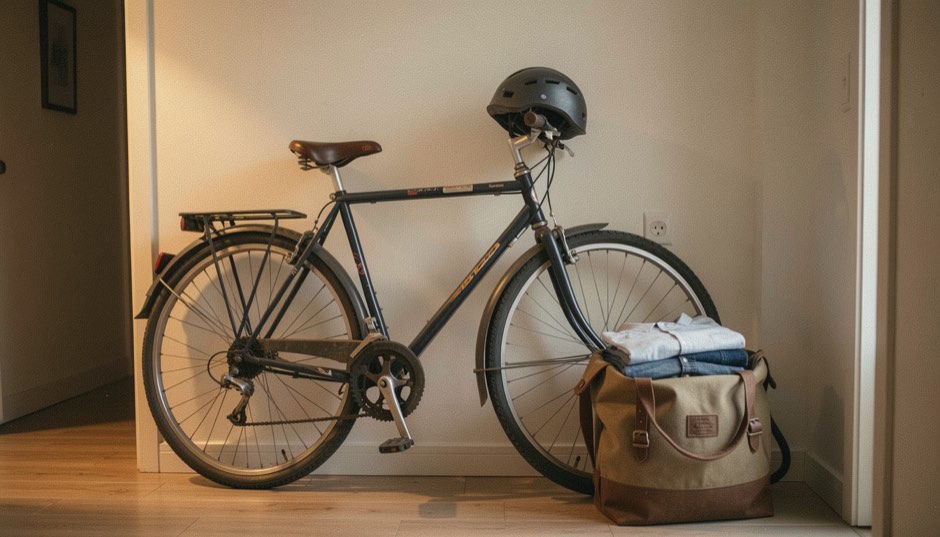
On the morning itself, ride at conversation pace. Arriving sweaty is a common worry, and pace is its first cure: a rider who does not race usually arrives presentable on a short trip. Find the bike parking before you need it, and write down whatever was harder than expected. That note is the plan for the second ride, which matters more than the first.
What if your town has no event?
Then the day still works, because its only fixed ingredient is the date. Pick the national date that suits your country, or World Bicycle Day on 3 June, which the United Nations General Assembly declared in 2018, and organise the smallest possible version: one colleague, one meeting point, one breakfast. A workplace that wants more can count the bikes at the rack that morning and compare the number a month later. In Europe, European Mobility Week is another natural hook. It has been a European Commission initiative since 2002, runs from 16 to 22 September every year and closes with Car-Free Day on the 22nd.
Why does one day matter if a habit takes a month?
Because a habit needs a start line. One day proves the route and the logistics; it does not turn anyone into a commuter. That is why several countries have stretched the day into something longer. Denmark's Vi Cykler til Arbejde, run by the Danish Cyclists' Federation, puts colleagues in teams every May, and its organisers counted 61,600 participants in May 2026. Germany's Mit dem Rad zur Arbeit runs from 1 May to 31 August. The day is the invitation; the weeks after it are where the change happens.
Our own thirty-day Commute Challenge follows the same logic: your ordinary trip, any bike, weather not an excuse, and a month to let the routine settle. Riding on Bike to Work Day and then starting the month the following Monday is a simple way to turn one morning into a habit.
Questions riders ask about Bike to Work Day
Do I need to register to take part in Bike to Work Day?
Not to ride. Some organisers ask for a pledge or a sign-up, which helps them count riders and plan their stations: Bicycle Network runs one for Ride2Work Day, and the Denver region enters pledged riders into a prize draw. Riding to work on the date is the only real requirement.
Is Bike to Work Day on the same date every year?
The rule usually stays while the date moves. Britain keeps the first Thursday of August and the Denver region the fourth Wednesday in June. The American national day sits inside Bike to Work Week each May; in 2026 it was Friday 15 May. Check the organiser's page each spring.
Does it count if I only ride part of the way?
Yes, in spirit. Cycling UK's description of Cycle to Work Day includes riding to work "or near enough", and a combined trip, bike to the station and train to the office, is a real commute by bike. It is also a sensible first step when the full distance feels too long.