Culture
Swimming and the family that rides: the pool trip and the first strokes
Teaching a child to swim works the way teaching a child to balance on a bicycle works: short sessions, no audience, and a rule against letting go before the child is ready. A parent who rides to work already owns the method, which is to start where the child is, keep the sessions frequent and stop before the fun runs out. What is left to solve is logistics, and for a car-free family that means a bike ride with a wet bag and one towel per swimmer. This page covers the pool trip, the strokes in the order they arrive, and how lessons are actually arranged.
How do I teach a child to swim without pressure?
Shorter and more often beats longer and rarer. A child who is allowed to stand up whenever they want will put their face in the water sooner than a child who is asked to trust an adult's arms, and the first weeks are about comfort rather than technique. Ten minutes of play at the shallow end, ending while it is still fun, teaches more than an hour of instruction that finishes in tears. Reward the attempt and never the depth, let the child set the pace of each small step, and keep the same routine every visit so the pool becomes predictable.
The Forth Swimmer, an independent magazine about swimming in Fife and the Firth of Forth, runs the same progression from a first splash to a life in the water, and its guidance on how to teach a child to swim keeps the order honest: water confidence first, floating and submersion next, and only then strokes, distance and the deep end. That order is worth defending against the temptation to skip ahead, because a child who is comfortable in the water learns every stroke faster afterwards.
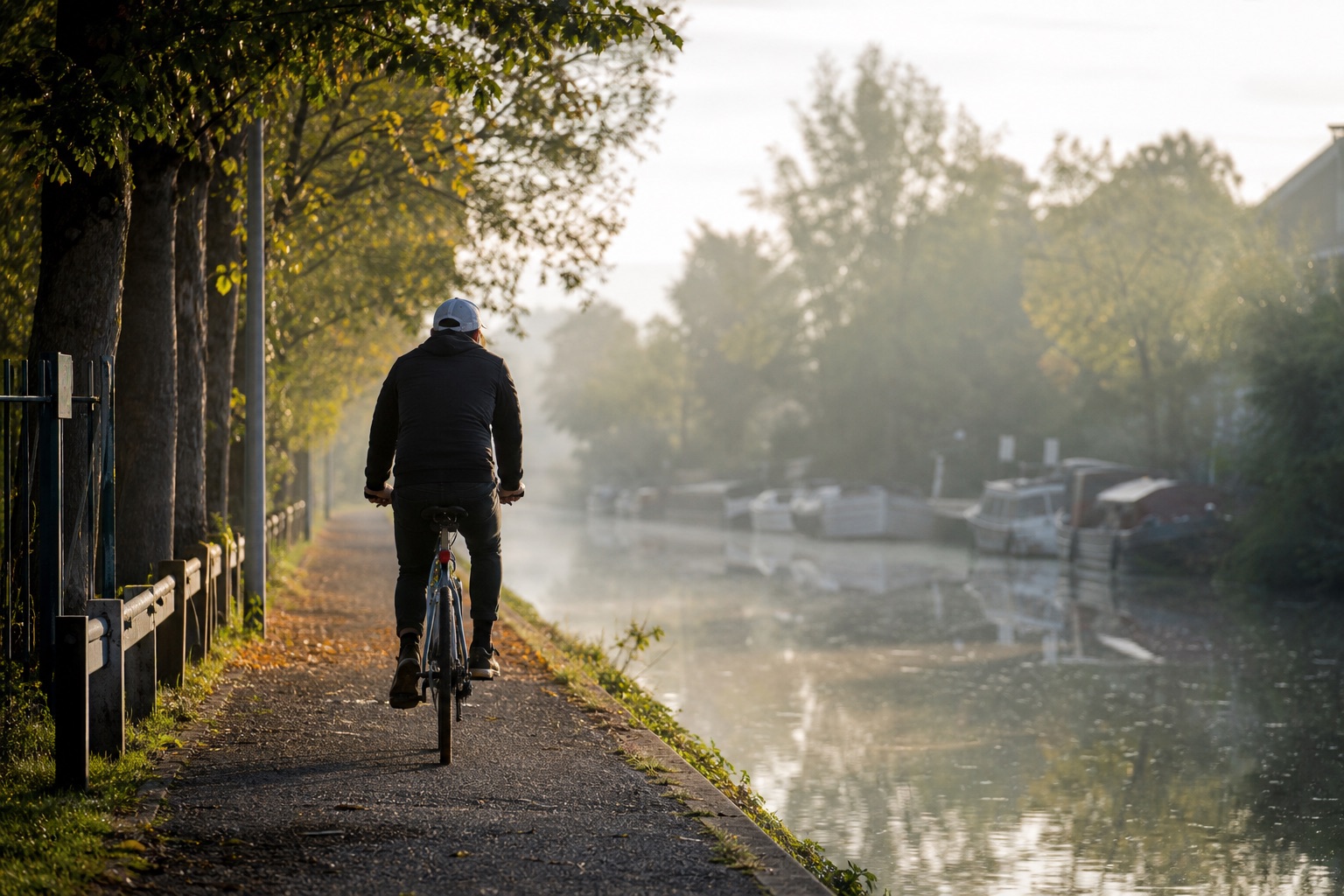
The pool trip when the bike is the family car
Family swimming is a logistics problem before it is a swimming problem, and the bike solves most of it. Panniers beat a rucksack for wet kit, because a towel and a costume in a bag on your back is a heavy, cold weight by the return leg; a dry bag inside a pannier keeps the dry clothes dry. Take one towel per swimmer, a bottle of water, and a fifty-pence piece for the locker, and ask the pool about family changing, hair dryers and where a bike can be locked within sight. The ride home is the part to plan: everyone is warm, damp and tired, so leave in daylight where you can, and keep the return short.
What is the difference between front crawl and breaststroke?
Front crawl alternates the arms, uses a continuous flutter kick and keeps the face in the water, breathing to the side; breaststroke moves both arms and both legs together, lifts the head for the breath and glides between strokes. Crawl is the faster of the two and the harder to make comfortable, because breathing is built into the rhythm of the stroke rather than added at the top of it. Breaststroke is slower, easier to see where you are going and usually the first stroke that feels manageable for a nervous swimmer. The mechanics of the faster stroke are set out in the description of front crawl, and the useful translation for a family is simple: breaststroke is the stroke to learn first, crawl the one to grow into, and a length of either is a good length.
How do children and adults learn to swim in Fife?
In Fife, as in most of Britain, the route runs through three doors: council or leisure-trust lessons, the Learn to Swim scheme a club runs from its own pool time, and one-to-one teaching for adults who never learned as children. The magazine covering the area follows all three, along with the clubs, the pools and the open water of the coast, so a parent can see what each path asks for before booking. Adults start differently from children: breaststroke first, goggles rather than pride, a lane where the bottom is visible, and a target measured in lengths rather than in technique. Nobody in a public lane is watching, which is the fact worth repeating about learning to swim late.
What a rider can take from a lane
A pool lane and a closed road share one idea: take a space out of ordinary traffic, and a skill becomes learnable in it. The extreme version of that idea is a public road shut for racing, which is the subject of reading the Isle of Man TT course, and the difference between the two tells you most of what you need to know about how riders learn anything.