Culture
The closed road: reading the Isle of Man TT course
The Snaefell Mountain Course is 37.73 miles (60.72 km) of ordinary public road on the Isle of Man, closed for racing and ridden clockwise from Glencrutchery Road in Douglas. It is the same surface a commuter crosses every morning, used for something the daily ride never does: a lap at racing speed, between walls and hedges, with the braking points written into the names of the corners. Reading that course is useful even to a rider who will never race there, because a closed road is an unusually clear lesson in how a road is shaped, and what the closure is worth.
How long is the Isle of Man TT course and where does it start?
The Snaefell Mountain Course is 37.73 miles (60.72 km) of public road, ridden clockwise, starting and finishing on Glencrutchery Road in Douglas. The Snaefell Review, an independent magazine on the Isle of Man TT and the Snaefell Mountain Course, treats the circuit as the first of its subjects: the closed road itself, its length and direction, its named corners and the places from which it can be watched. Its guide to the snaefell mountain course length gives the figure that governs everything else on the island, because a course of that size is not a circuit in the ordinary sense: it is a town, four parishes and a mountain joined by the same tarmac, closed for the afternoon.
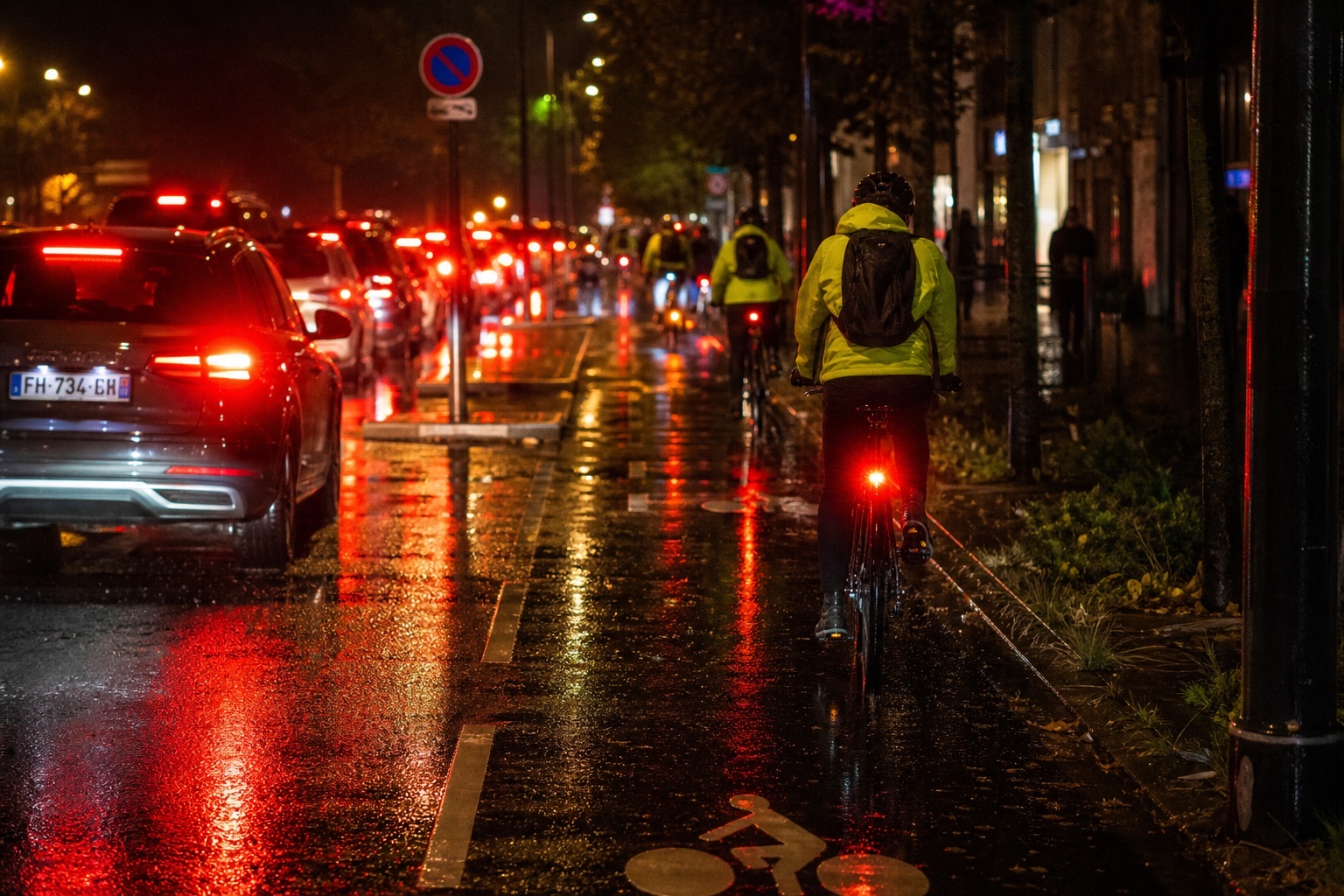
The same tarmac as your commute
What the course is made of is unremarkable: the same asphalt, camber, drain covers, painted lines and hedge shadows as any road between a village and a town. What changes is the closure. Racing removes oncoming traffic, parked cars, side roads and pedestrians, and that removal is the whole difference between a road at eight in the morning and a road at racing speed. A commuter reading a route is doing the same work at a lower pace: which corners are blind, where the surface breaks up, which lane drains, which junction produces a car that has not seen you. The road does not change its mind; the conditions do.
What are the named corners of the Isle of Man TT course?
The course is remembered corner by corner, and the names amount to a map of the lap: Bray Hill, Quarter Bridge, Braddan Bridge, Ballacraine, Glen Helen, Kirk Michael, Ballaugh, Sulby, Ramsey Hairpin, Waterworks, the Gooseneck, the Bungalow, Windy Corner, Keppel Gate, Kate's Cottage, Creg-ny-Baa, Hillberry, Signpost Corner and Governor's Bridge, before the return to the Grandstand. Named corners matter because they are what a rider memorises: not a view but a sequence of decisions in order, each one prepared before it arrives. The corners are listed in order, with the road they belong to, in the record of the Snaefell Mountain Course. Reading a familiar route as a list of named features is a habit worth stealing, whether the lap takes twenty minutes or four.
Why is Bray Hill famous at the Isle of Man TT?
Bray Hill is the first serious descent of the lap, seconds after the start, and it runs through an ordinary residential street with spectators at the kerb. It is famous for that collision of scales: a racing machine at speed on a road with front doors on it, in the first moments of a lap, before anyone has settled. Its position in the lap is what makes it famous rather than its shape, and the position is also the lesson, because the first descent of any ride sets the tone for the rest: cold tyres, full attention, and a line chosen before the corner rather than in it.
What a rider takes from a racing line
Braking markers, an apex, an entry speed and the discipline of riding the same line twice are not racing secrets; they are the vocabulary of anyone who wants a descent to feel the same on a wet Tuesday as it did in July. The rest of the analogy runs back to the water, where the same principle is taught to children: a controlled space, a repeatable line and a skill that survives leaving it, as set out in the notes on swimming and the family that rides.